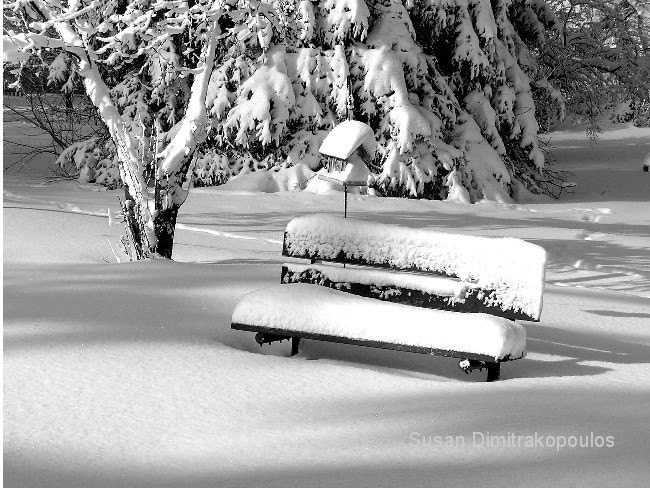
As I contemplated "white" this week, my mind turned, not surprisingly, to the idea of snow...it's part of life here in South Dakota this time of year. This year, it seems, it's also a part of life for many folks that don't usually get to see it, including my brother in Athens, Georgia, who reported six inches of snow there the other day, just as we were getting our six inches here.
I thought about those beautifully delicate snow crystals that collect themselves together to form each single snowflake that falls, gently blanketing the landscape in unearthly quiet and the stunning white of reflected light. I thought of Wilson A. Bentley, a self-educated Vermont farmer who began to photograph snowflakes late in the 19th century by adapting a microscope to a bellows camera in order to capture an image of something so fleeting. Throughout his life he photographed thousands of them and in the process began an amazing collection of snowflake images of infinite variety. I didn't know it until this week, but there is a museum dedicated to him in his hometown of Jericho, Vermont, along with a website which you can find
here. You can see a collection of images online and there are many books available as well, but here are a few chosen beauties:
My further wanderings into the world of snowy whiteness led me to the National Snow and Ice Data Center, a vast storehouse of information and little-known facts. It was through their website, found
here, that I learned that in 1953, 187 inches of snow fell within seven days at Thompson Pass, Alaska and that in the western United States, snowpack contributes up to 75 percent of all year-round surface water supplies! And get this...the answer to your burning question....why is snow white? Here is the answer they give:
"Visible sunlight is white. Most natural materials absorb some sunlight which gives them their color. Snow, however, reflects most of the sunlight. The complex structure of snow crystals results in countless tiny surfaces from which visible light is efficiently reflected. What little sunlight is absorbed by snow is absorbed uniformly over the wavelengths of visible light thus giving snow its white appearance."
Fun facts to know and tell abound there....including some pretty fascinating photographs like this:
The Great Blizzard of March 12, 1888, New York City
And then I found some great artistic images of snow from a few wonderful photographers on etsy. There were so many to choose from, so here is a small selection:
For those of you that live in a place with a winter that looks like this, stay warm and enjoy the season!